
Self-Sealing Anti-Spill Filters: The Science Behind Automatic Flow Shutoff
A self-sealing filter has one job that sounds contradictory: stay wide open to air, then shut completely the instant liquid arrives. No moving parts, no float, no electronics. Understanding how that works makes it much easier to specify the right grade.
The mechanism
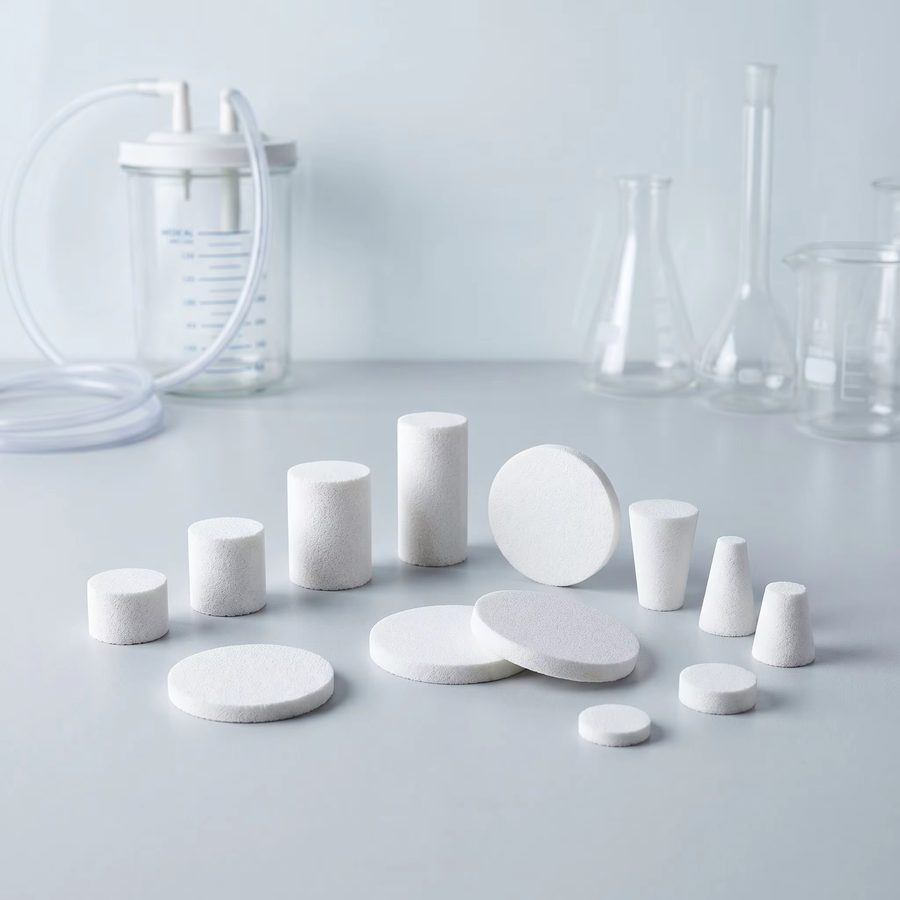
Self-sealing media is sintered from ultra-high molecular weight polyethylene powder. The particles fuse at their contact points, leaving an interconnected pore network running through the element. In the dry state that network is simply an air path, and pressure drop across it is low.
The surface chemistry is where the behaviour comes from. The polymer backbone is inherently hydrophobic, but the media is treated so that water entering a pore is drawn in by capillary action rather than repelled. Once liquid occupies the pore throat, surface tension holds it there. Air can no longer pass, and the element becomes a barrier. Because the pores are small, the capillary force is strong enough to resist meaningful back pressure.
What pore size actually controls
Two properties pull in opposite directions. Smaller pores seal faster and hold back higher pressure, but they also restrict airflow in the dry state. Larger pores breathe freely but need more liquid contact before they close, and they release under lower back pressure. Choosing a grade means deciding which side of that trade-off your application sits on.
| Pore band | Dry airflow | Sealing behaviour | Typical use |
|---|---|---|---|
| 0.1 - 0.45 um | Restricted | Fastest seal, highest hold pressure | Medical suction, IVD |
| 1 - 10 um | Moderate | Fast seal, moderate hold | Drum and container vents |
| 10 - 40 um | Free | Slower seal, lower hold | Bulk venting, coarse protection |
Where it beats a float valve
Mechanical float valves are the traditional answer to overflow protection. They work, but they have failure modes that a sintered element does not.
- A float needs clearance to travel. Sintered media has no moving part to jam with debris or dried residue.
- Floats are orientation dependent. A sintered element seals regardless of how the housing is tilted.
- Float assemblies add several components. A sintered plug is one part, which simplifies assembly and reduces the bill of materials.
- In single-use medical devices, a moulded polymer element is far easier to justify on cost than a multi-part valve.
Specifying it correctly
When you send an enquiry, the three numbers that matter most are the airflow you need in the dry state, the maximum back pressure the sealed element must hold, and the liquid it will contact. Temperature and any sterilisation method should be stated as well, since gamma and EtO tolerance differ from steam.
Geometry is usually the easy part. We cut and mould to the housing you already have, so an existing product does not need redesigning around a new filter.
Need this specified for your application?
Send the operating conditions - medium, temperature, flow rate and target retention - and our engineers will recommend a grade and geometry, or develop a custom element for your housing.