
Filtration Considerations for Semiconductor Wet Process Tool Venting
Wet benches handle hydrofluoric, sulphuric and ammonia chemistries in the same tool. Vent filtration has to survive that environment and contribute nothing back to the process. The requirements are narrow.
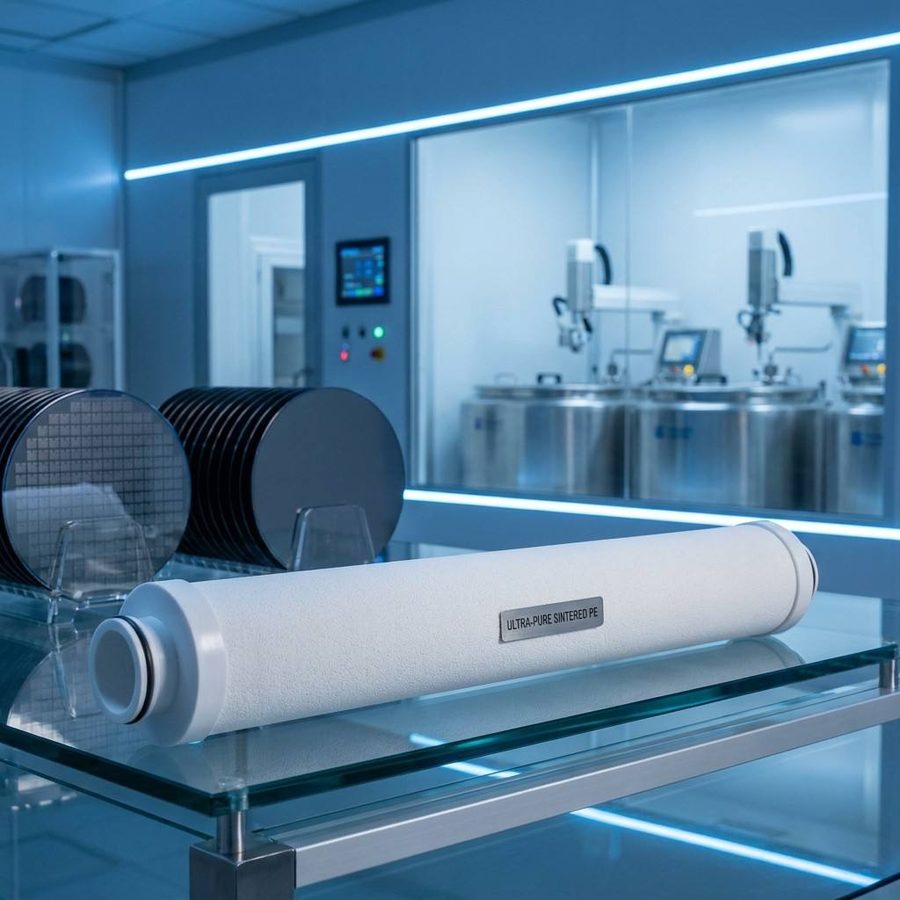
Why metal is usually excluded
Trace metal contamination is the dominant concern in semiconductor wet process. Even highly corrosion-resistant alloys can contribute measurable ions under aggressive chemistry, and at advanced nodes the tolerance for that is essentially zero. Metal-free construction removes the risk category entirely.
Sintered UHMWPE is the usual answer. It resists hydrofluoric acid, which attacks glass and many metals, and it maintains structure across the pH range these tools operate in.
Specification points
- Metal-free construction throughout, including any support hardware in contact with the vent path.
- UHP-grade resin with documented extractables, not general-purpose polymer.
- Cleanroom packaging, double bagged, with particle counts stated.
- Hydrophobic treatment so condensate does not blind the vent path.
Sizing the vent
Vent filters are commonly undersized. The element must pass peak displacement flow during a rapid fill or drain, not just the steady-state rate. Undersizing shows up as pressure excursions in the tank rather than as an obvious filter failure, which makes it hard to diagnose after the fact.
Send us the tank volume and the fastest fill and drain rates. We will size the element against peak flow with margin, rather than against an average.
Need this specified for your application?
Send the operating conditions - medium, temperature, flow rate and target retention - and our engineers will recommend a grade and geometry, or develop a custom element for your housing.