
Sintered Porous Polymers vs. Sintered Metals: A Material Selection Guide
Polymer or metal is the first fork in the road, and getting it wrong wastes a prototype cycle. This guide compares the five base materials we sinter, and the conditions that should push you toward each one.
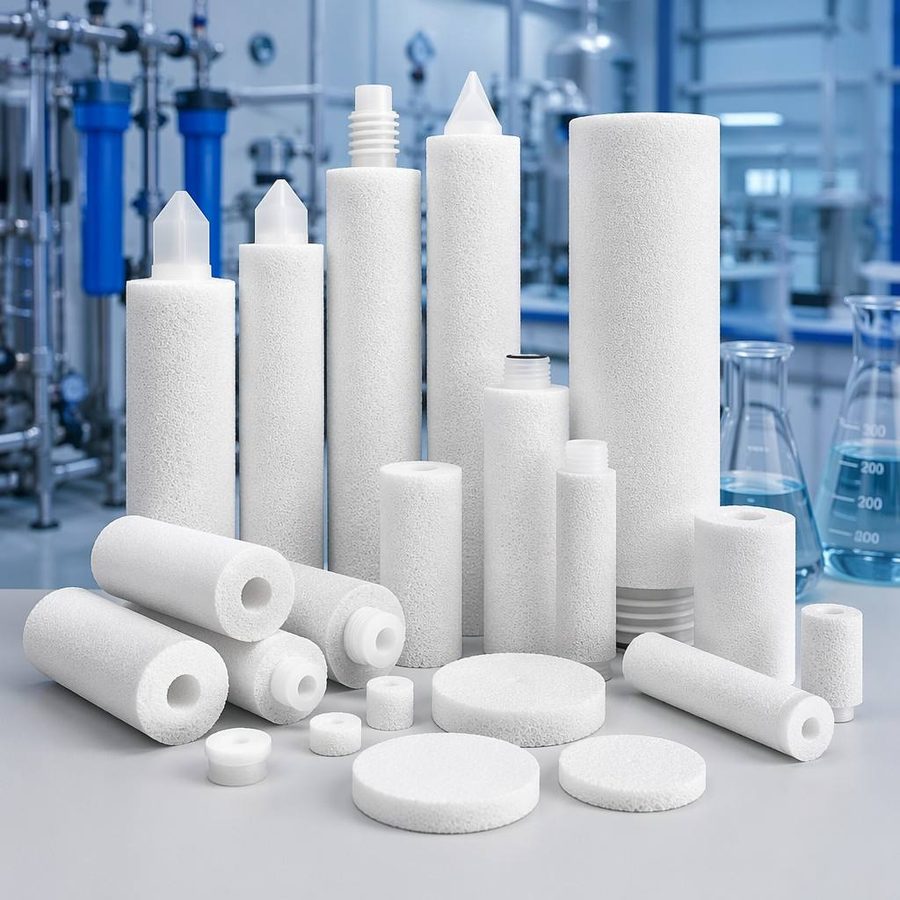
The five platforms
| Material | Max temp | Chemical tolerance | Notes |
|---|---|---|---|
| UHMWPE | Around 80 C | Very broad, weak to strong oxidisers | Biocompatible, low extractables |
| PE | Around 70 C | Broad | Lowest cost polymer option |
| PP | Around 100 C | Strong acid and alkali | Preferred for battery and acid service |
| 316L stainless | Over 400 C | Broad, not for chlorides | Cleanable, reusable, steam capable |
| Bronze | Around 200 C | Moderate | Best acoustic damping for pneumatics |
When polymer wins
Polymer media contributes no metal ions. In semiconductor wet process, in vitro diagnostics and any analytical workflow sensitive to trace metals, that alone decides the question. Polymers are also far cheaper to mould into complex geometry, which matters for disposable devices produced in volume.
The ceiling is temperature. Above roughly 100 degrees Celsius, polymer options run out and the decision moves to metal regardless of other considerations.
When metal wins
- Steam sterilisation in place, where the element must survive repeated cycles.
- High differential pressure that would deform a polymer structure.
- Applications requiring backflushing and reuse over a long service life.
- Catalyst recovery and other process duties at elevated temperature.
Bronze is a special case
Sintered bronze is rarely chosen for filtration efficiency. It is chosen for acoustics. In pneumatic exhaust, the tortuous pore path breaks up the pressure wave and cuts noise substantially while keeping back pressure low enough that cylinder cycle time is not affected. No polymer matches it for that duty.
A practical shortlist method
Work through the constraints in this order: temperature ceiling, then chemical compatibility, then contamination limits, then cost. Temperature and chemistry eliminate options outright. Contamination narrows what remains. Cost decides between whatever survives.
Need this specified for your application?
Send the operating conditions - medium, temperature, flow rate and target retention - and our engineers will recommend a grade and geometry, or develop a custom element for your housing.