
Battery Venting: Protecting Li-Ion and Lead-Acid Packs from Moisture Ingress
A sealed battery enclosure is not really sealed. It has to equalise pressure as temperature and altitude change, while keeping water and dust out. That contradiction is what a vent element resolves.
Two different problems
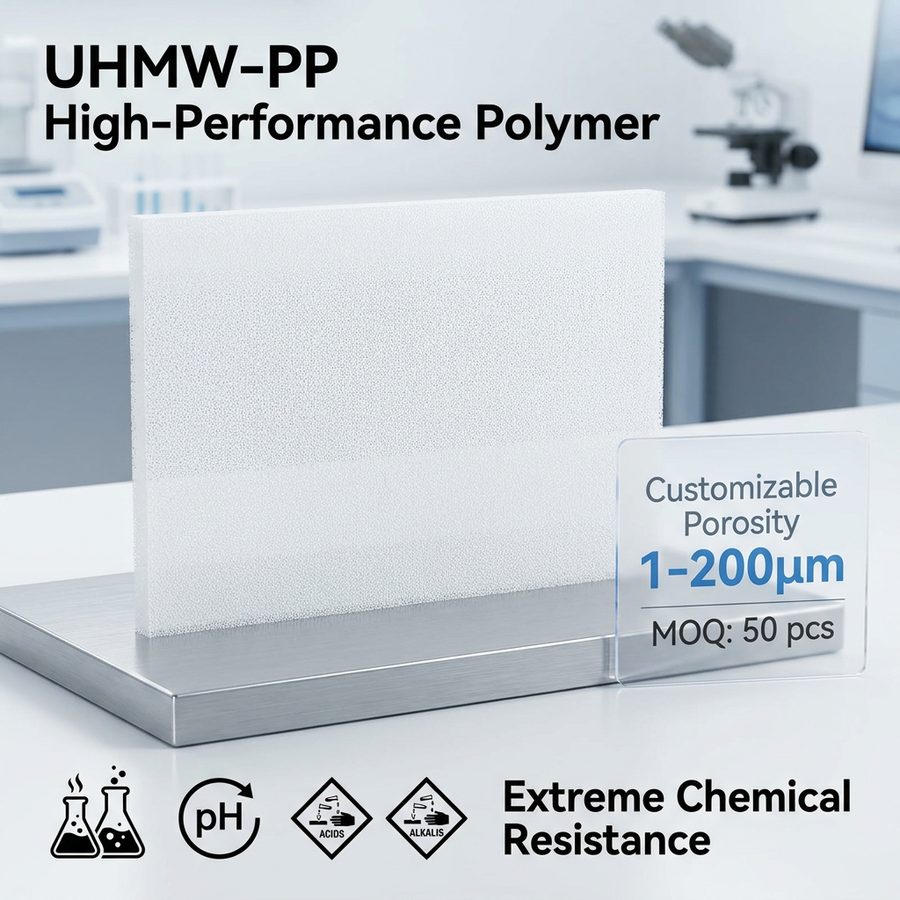
Lead-acid and lithium-ion packs both need venting, for different reasons. Lead-acid banks generate hydrogen and oxygen during charging, and that gas must escape or the enclosure pressurises. The vent path also has to survive sulphuric acid mist, which rules out most polymers other than polypropylene.
Lithium-ion packs generate far less gas in normal operation. Their venting requirement is about pressure equalisation across temperature and altitude swings, while maintaining an IP rating against water ingress. A hydrophobic sintered PE element handles this without compromising the seal.
| Requirement | Lead-acid | Li-ion pack |
|---|---|---|
| Primary duty | Continuous degassing | Pressure equalisation |
| Chemical exposure | Sulphuric acid mist | Minimal |
| Preferred media | Sintered PP | Hydrophobic sintered PE |
| Water ingress spec | Splash resistance | IP67 or higher typical |
How hydrophobic venting works
The pore network passes air freely, but liquid water cannot enter without exceeding the water entry pressure of the media. That threshold is set by pore size and surface energy. Below it the element is a perfect water barrier while remaining fully breathable, which is what allows a housing to hold an IP rating and still equalise pressure.
Practical selection
Give us the enclosure volume, the expected temperature range, the target IP rating and the mounting geometry. For lead-acid service, add the expected gassing rate at maximum charge current. We will recommend an area and grade, and can supply the element as a plate, disc or moulded plug depending on how it mounts.
Need this specified for your application?
Send the operating conditions - medium, temperature, flow rate and target retention - and our engineers will recommend a grade and geometry, or develop a custom element for your housing.