
Reducing Pneumatic Exhaust Noise Without Sacrificing Flow
A plant running dozens of pneumatic cylinders produces a constant sequence of exhaust bursts. Silencers fix it, but a badly chosen one slows the machine down. The trade-off is worth understanding.
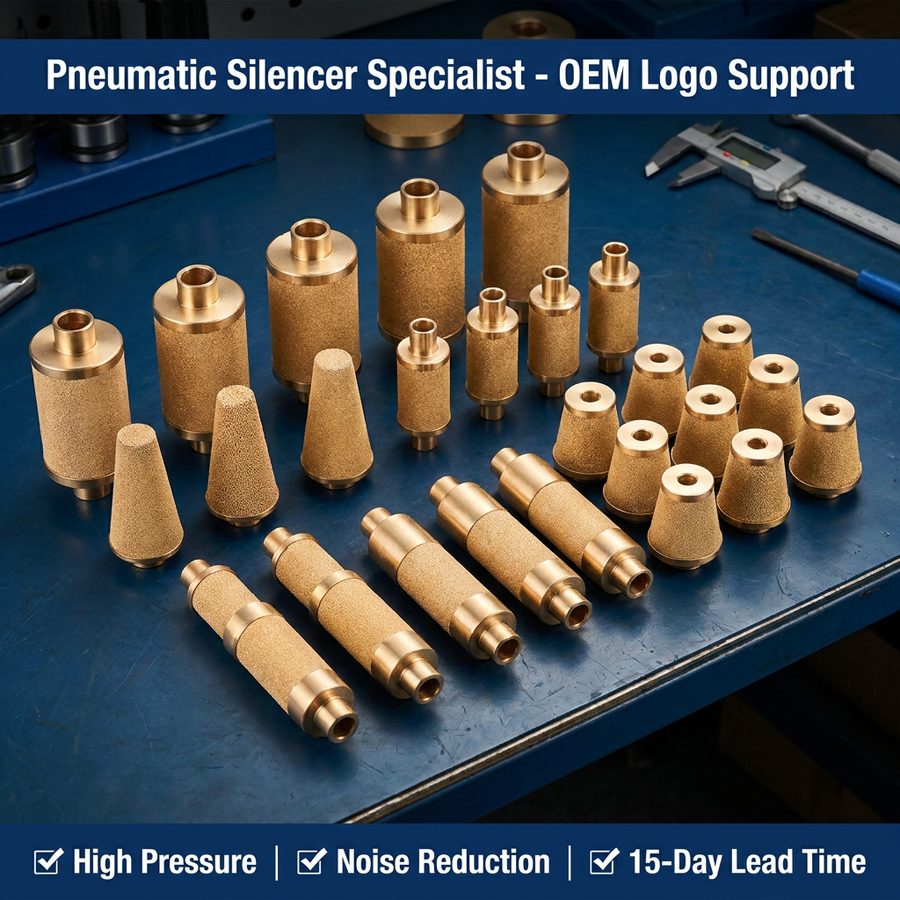
How a sintered silencer works
Pneumatic exhaust noise is a sharp pressure wave released into open air. A sintered bronze element does two things to it. The tortuous pore path breaks the wave into many small flow paths, which cuts the peak amplitude. It also spreads the discharge over a longer interval, shifting the energy toward higher frequencies that attenuate more quickly in air.
The result is a noticeably quieter exhaust without any active component or maintenance requirement in normal service.
The back pressure cost
Every silencer adds resistance to the exhaust path. That resistance slows the cylinder return stroke, and on a fast cycling machine the effect compounds across the line. Choosing the finest available porosity to maximise quiet is the classic mistake.
| Porosity | Noise reduction | Back pressure | Suitable for |
|---|---|---|---|
| 10 - 20 um | Highest | High | Low cycle rate, noise critical |
| 30 - 50 um | Good | Moderate | General automation, most cases |
| 60 - 100 um | Moderate | Low | High speed cycling |
Maintenance in dusty plants
Silencers load up from the inside. Compressor oil carryover and moisture accumulate in the pore structure, and back pressure rises gradually. In a clean plant an element may run for years. In a dusty or humid environment with poor air preparation, expect a much shorter interval.
Bronze elements can be cleaned in solvent and reused, unlike moulded plastic silencers. Where a machine has many exhaust ports, that difference adds up over the equipment life.
If cycle times have drifted on an older machine, check the silencers before suspecting the valves.
Need this specified for your application?
Send the operating conditions - medium, temperature, flow rate and target retention - and our engineers will recommend a grade and geometry, or develop a custom element for your housing.